

 ॐ गुरुपरमात्मने नमः
perception and khyāti
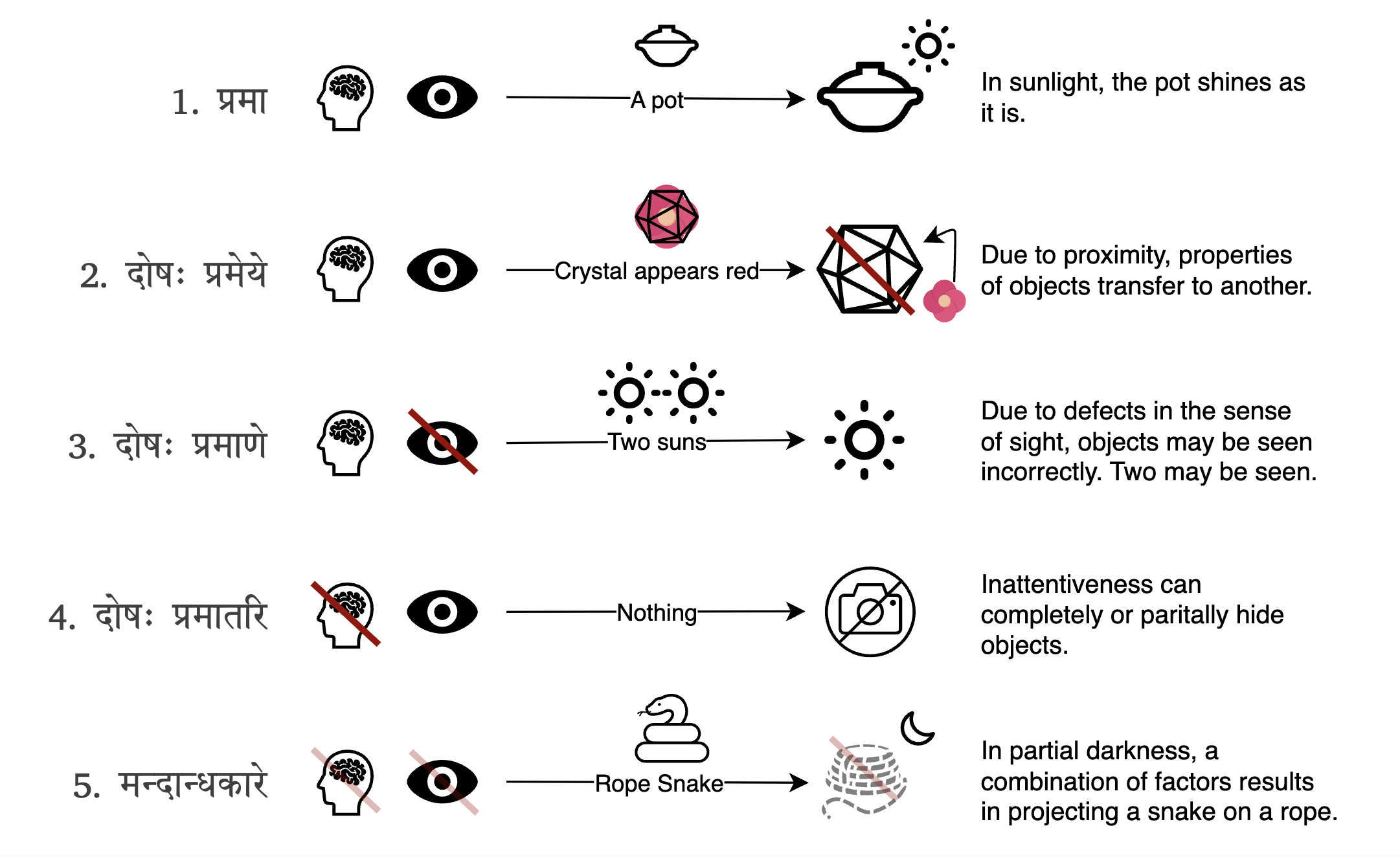
This diagram below presents a simplified view of perception and error. The lakṣaṇas for khyāti and their causes are not described here.
-
We can see objects as they are. In sunlight, we perceive the pot as is.
-
Error can occur in the objects themselves. The sky appears blue. A crystal placed on a red flower appears red. The eyes and mind are not causing bhrama.
-
Error can occur in our eyes. We may see two suns in the sky, or a blurry sun. The mind and object are not causing bhrama.
-
When the mind is not focused on an object, the object isn’t perceived – with or without error. The eyes and object are not causing bhrama.
-
Error can occur in our mind. When a rope is not fully visible, or the eye does not properly function, we fill in the details with previous impressions and perceive other objects.
Thus, cognition occurs at the intersection – where the mind, through the senses, contacts the perceivable object.
The mind doesn’t distinguish between a crystal that appears red, or a crystal that is red. It perceives a red crystal – which it may have projected there! The mind regularly projects objects on the site of attention – where the mind pervades the object through the sense organs.